
Gradually, Then Suddenly
Let's talk about Saks, the best time to plant a tree, what I'm up to at the NRF Big Show. Plus the top 5 episodes of 2025 from the pod.

Gradually, Then Suddenly

“How did you go bankrupt?” Bill asked. ‘
“Two ways,” Mike said. “Gradually, then suddenly.”
- Ernest Hemingway, The Sun Also Rises
You don’t have to have spent as much time as I have in the retail industry—coming up on 35 years (yikes!)—to know that we’ve lost a lot of iconic brands to the retail graveyard.
Just last week, the New York Times published an article documenting the long, slow decline of Sears, where I happened to start my retail career. IMHO a documentary I participated in did a better job of chronicling the reasons for the decline. But I digress.
Yet as much as we’ve seen various disruptive forces become more powerful, often moving at a breathtaking pace, it is usually the case that the seeds of any organization’s undoing were planted many years earlier.
We’re About to Begin Our Initial Descent
In 2004 I joined the senior leadership team at the Neiman Marcus Group, which at that time was the largest and most profitable luxury department store chain in the world. Shortly thereafter we sold the company to private equity for $5.1 billion.
Over the next few years sales and profit growth was outstanding. Our e-commerce business was on fire, with double digit gains each year and among the best sales penetration of any retailer of any kind. For fiscal 2008 our sales exceeded $4 billion and our EBITDA rate was in the mid-teens, far surpassing our main rival Saks Fifth Avenue.
Now, as you may have heard, subsequent events did not go so well.
I’ll spare you chapter and verse of what we might charitably call the “speed bumps” of the GFC (I very luckily departed Neiman’s several weeks before Lehman Brothers went bust), a very poorly structured 2013 LBO, and an inevitable trip through bankruptcy court hastened by the pandemic.
And yet, despite having off-loaded $4 billion in debt through its 2020 restructuring, Neiman’s mostly continued to flail, and just over a year ago found itself being acquired by its far weaker rival for a measly $2.7 billion. Now you don’t have to be too good at finance to recognize that is a mind-blowing amount of value destruction.
Saks Education*
The formation of Saks Global in December of 2024 brought together three legendary luxury retail names (Saks Fifth Avenue, Neiman Marcus, and Bergdorf Goodman) with the promise of massive synergies and the creation of a new luxury department store model crafted to win the future.
Many (including this guy) believed that such a marriage was inevitable. In fact, I worked on it in some capacity three different times across 15 years—once when I was at Neiman’s and twice as an advisor to potential investors.
Yet, despite the conceptual advantages of consolidation and rationalization, the deal has been, well, I believe the technical term is “a shit show,” from day one, causing many (including this guy) to see a now very much rumored bankruptcy as the likely outcome.
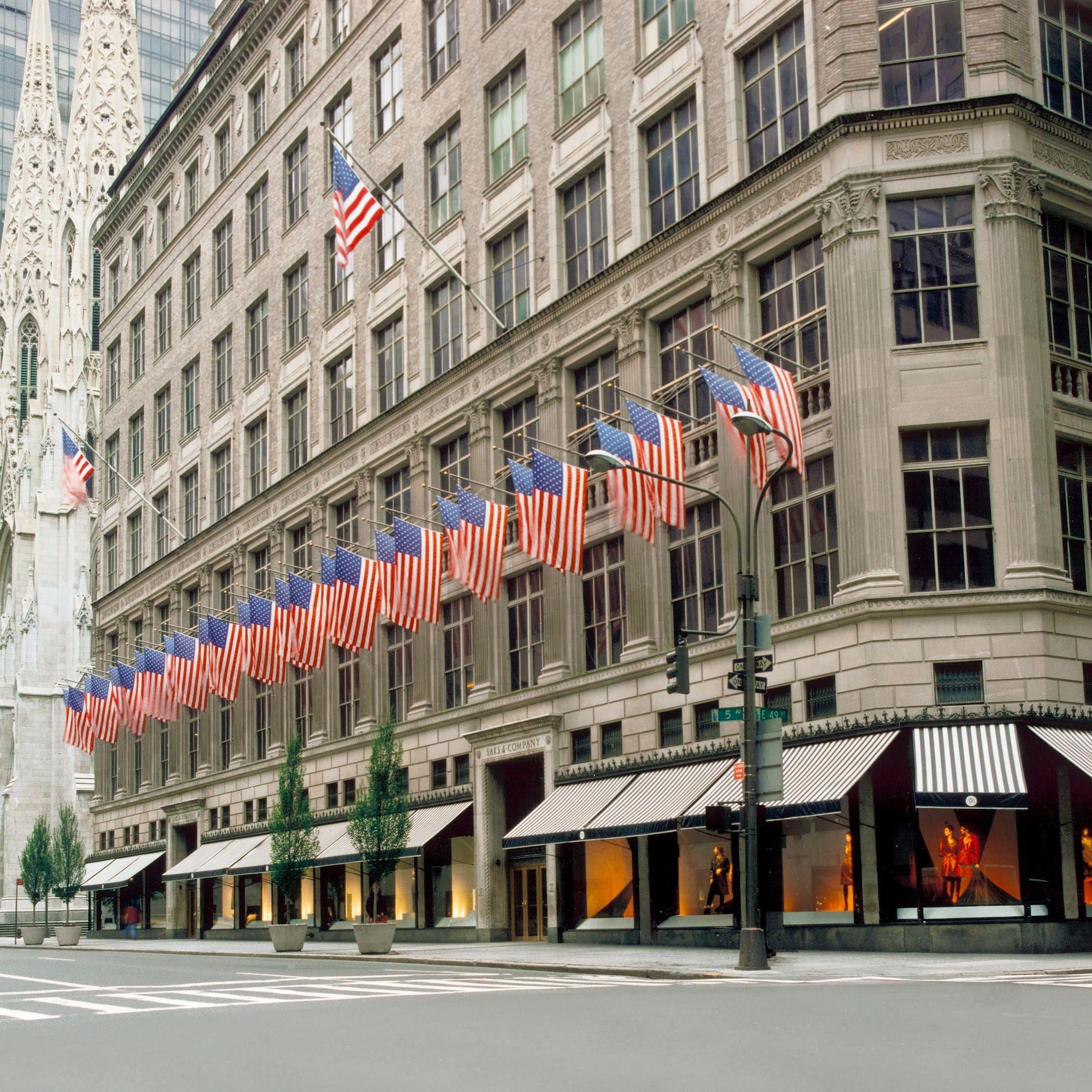
Source: Saks Global
At the surface it is all too easy to cast a cynical eye on Richard Baker, the deal’s impresario, or heap blame on the absurd capital structure and wild eyed assumptions.
But the real reason two once proud companies are edging ever closer to the precipice cannot simply be blamed on too much debt or poor management. We got here because of a series of mistakes that were made over multiple years starting some two decades earlier.
Watching the Last 20 Years Happen to You
The collapse of the North American luxury department store sector will no doubt be the subject of many.a business school case. But the strategic reasons for the decline that extend beyond the machinations of private equity deals, Black Swan events, and/or operational missteps are pretty straightforward.
Driving same-store sales primarily through price increases, not customer growth. In the four years I was at Neiman Marcus our average unit retail price growth comfortably exceeded our same-store sales. Despite opening new stores, our customer growth came mainly from e-commerce. Transaction growth declined for all but our top customer segment every year. This is not the sign of healthy customer base, particularly for one with growth ambitions.
Narrowing the relevant addressable market. We raised average prices through assortment choices and migrated the mix to be higher-end and more exclusive. The effect of this is we chased a lot of customers away (mostly to Nordstrom and Bloomingdale’s). As I talk about in my most recent book, narrowing your customer focus to become more meaningful (and profitable) is often an excellent strategy. But if you are trying to add stores and the stores you have are built to serve a far wider audience you eventually have an economic model that—spoiler alert—hits a wall.
Failure to acquire younger customers. Points 1 and 2 largely help to explain this. Younger customers generally have less money. Older, wealthier customers generally start spending less on stuff as they age—and obviously eventually and literally die off. But demographic trends also don’t favor the multi-line department stores and their multi-level cavernous physical manifestations.
Ignoring competition from vendors. 20 years ago relatively few core vendors to Neiman Marcus and Saks had their own stores, and if they did there were just a handful of them in major gateway cities. Many also didn’t sell their products online. Today, virtually every top mall and lifestyle center has more than a dozen high end, mono-brand stores. All the major luxury conglomerates (LVMH, Kering, Tapestry, Capri) have robust e-commerce offerings and have collectively opened hundreds of stores, most of which are within short walking distance of a Saks or Neiman’s location.
In sum, the competitive landscape is vastly different from what it was two decades earlier (including the ascendency of online-only players), and the effect is that the addressable market for Saks Global has contracted dramatically. Throughout this period Saks and Neiman’s largely sat around and watched, or simply engaged in financial re-engineering and store closings, none of which does anything for customer relevance and differentiation.
In the Absence of a Time Machine…
Having led strategy at both Sears and Neiman Marcus I can tell you with great confidence that many of the most important and crippling issues were well known to leadership at a time when different actions could have been taken. If my various NDAs did not require me to destroy documents in my possession I could prove this rather easily with a few choice Board presentations I prepared.
In Sears case, stick a fork in them, they’ve been done for a long time.
In the matter of Saks Global, things do look pretty dire. Reports have Chanel pulling completely out of multiple Neiman’s stores and some shelves are already growing bare as many vendors stopped shipping weeks ago and other vendors have been told not to ship by Hildun, a leading factoring firm. Without new financing very soon there will be little product available for the upcoming and critical spring season.
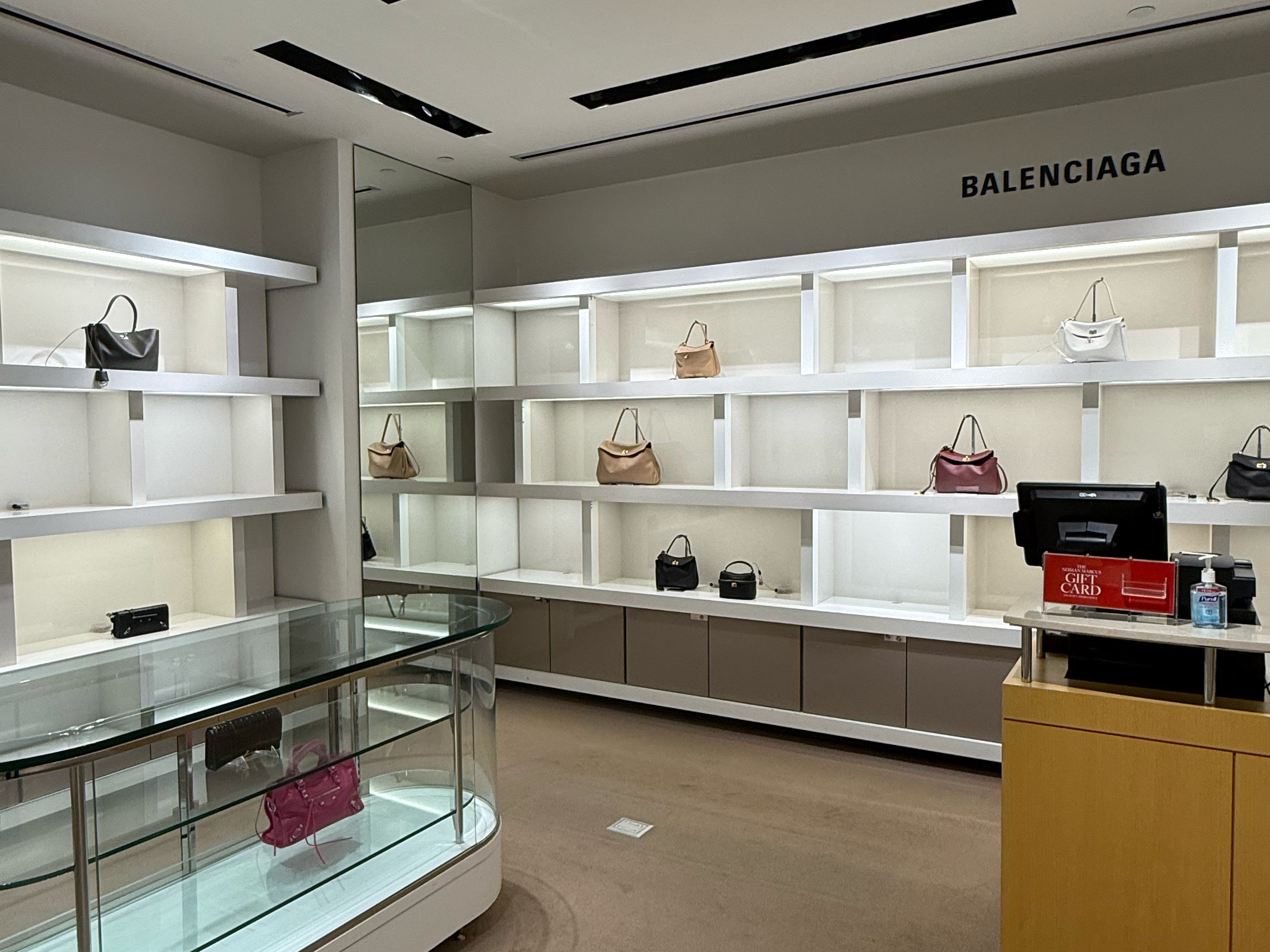
Source: Author photo taken at Neiman Marcus, Town Center at Boca Raton, December 29, 2025
My best guess is that Saks Global will file Chapter 11 within the next couple of weeks, rather than liquidate. In many respects they are too critical to the luxury retail and real estate sectors to be allowed to fail.
Their reorganization will likely spur the closing of 8 to 10 overlapping locations, multiple sale leasebacks, and perhaps a spin off of Bergdorf Goodman. This should create a “workable” balance sheet and wll get critical spring shipments flowing—but ultimately not create the cash flow to resize and modernize their brick-and-mortar locations and invest in technology in a way that positions them to regain meaningful, profitable market share.
As with everything, time will tell.
Of course it would be awesome if we had a time machine that, once we killed Hitler, would allow us to address the egregious mistakes of the past. Alas, barring an unexpected announcement from CES we are stuck dealing with our present circumstances and the limits of our imagination.
The Best Time to Plant a Tree
The sad demise or journey into the zone of irrelevance for so many retail brands can often be seen as idiosyncratic or just plain bad luck. But most often it is a series of bad decisions, steeped in ego, ignorance, and fear made over many, many years.
It may appear to come on suddenly, but it is anything but.
Our mission—if we choose to accept it--is to open the aperture and see that more and more competition is coming from unexpected places.
Our mission—if we choose to accept it—is to see that in times of intense disruption playing it safe is actually the riskiest choice of all.
Our mission—if we choose to accept it—is to be customer obsessed and data informed. We must break through our denial and be willing to act on our insights. Not tomorrow, but today.
“The best time to plant a tree was 20 years ago. The second best time is now.”
- Chinese proverb
* H/T to Lauren Sherman and the folks at Puck for their excellent coverage.
WHERE IN THE WORLD IS STEVE?
Next week I’ll be hanging out with over 30,000 of my closest friends at the NRF Big Show in the cozy confines of the Javits Center. If you’re there I’m sure we’ll run into each other. But if not, feel free to send me a note. It’d be fun to say “hi.”
We’re also recording episodes of the Remarkable Retail Podcast in our dedicated remote podcast studio on the Expo Floor, brought to you by our friends at Narvar. Narvar is the #1 platform for intelligent personalization, helping over 1,500 of the world’s leading brands transform the post-purchase experience into a strategic growth engine.

EVERY YEAR IS A LEAP YEAR…
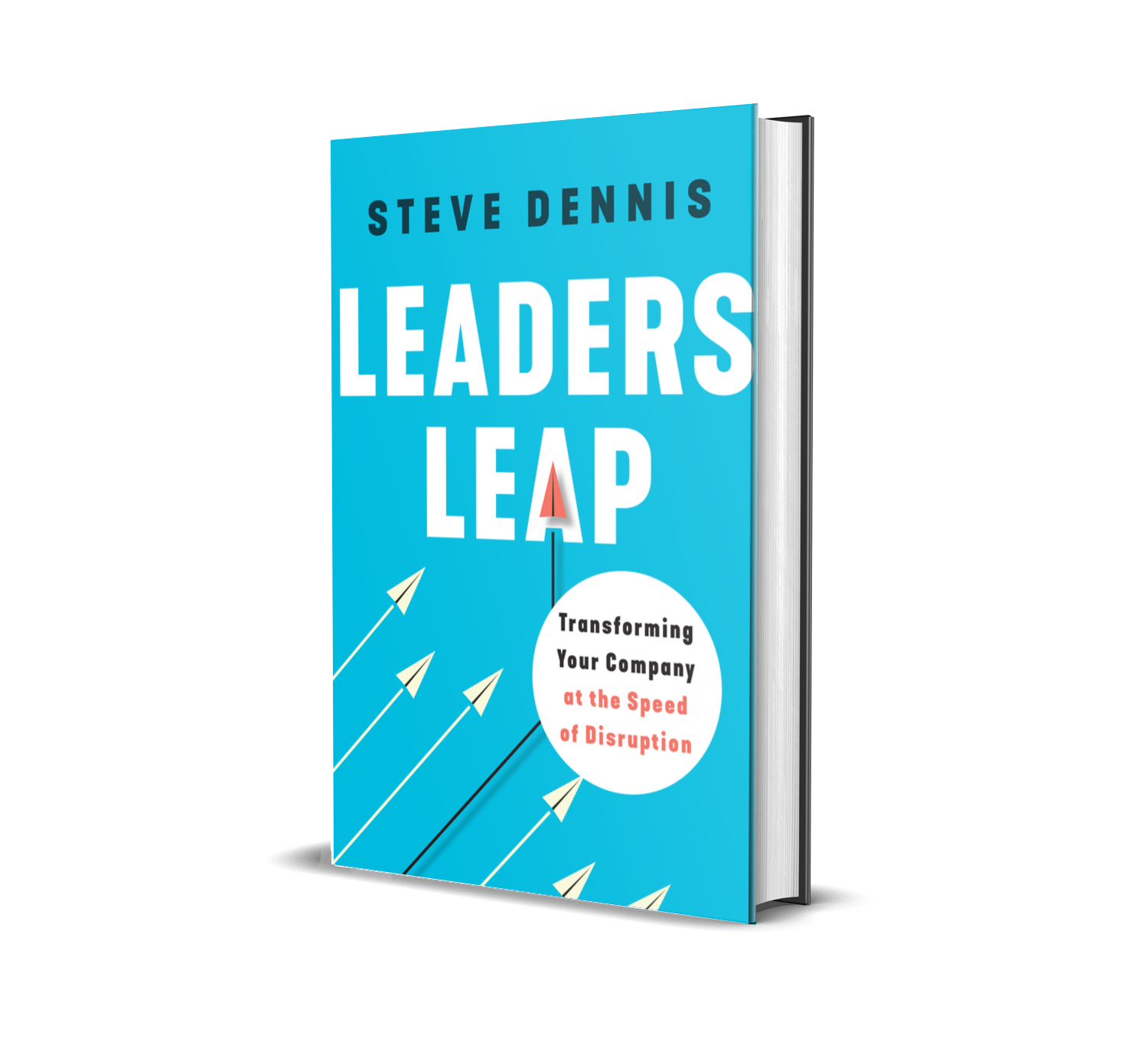
But only if you accept that playing it safe is often the riskiest thing you can do. Laggards linger. Leaders Leap.
ON THE POD
The Remarkable Retail Podcast is among the most listened-to podcasts globally—and is the only retail podcast hosted by two of the NRF’s Top Voices for 2025 and 2026.
Our new season debuts on Tuesday. Check out our trailer here.
In the meantime, why not get caught up on our top 5 episodes from 2025.
#1: People-led, Tech Powered with Sam’s Club CEO Chris Nicholas
#2: Vuori Founder & CEO Joe Kudla Live on Stage at CommerceNext
#3: Why Amazon Can’t Crack Grocery” with Jason Goldberg
#4: “The Analysts” w/ Sucharita Kodali, Neil Saunders, & Simeon Siegel
#5: Retail Apocalypse 2.O?
IF THIS NEWSLETTER RESONATES . . .
…and you want to take our relationship to the next level, here are 3 ideas:
BOOK AN ADVISORY VIDEO CALL. I’m now live on Intro.co for 1:1 concise and high impact advisory calls. Through the end of January I’ll be donating 100% of my proceeds to World Central Kitchen. Secure time here.
BRING ME TO YOUR NEXT EVENT TO SPEAK. I’ve delivered inspiring keynotes at major industry conferences on six continents, as well as been a featured speaker at dozens of corporate events, customer dinners, book signings, and the like.
SHARE THIS NEWSLETTER with a friend or colleague.
Steve, you make it painfully clear that retail collapses are like glaciers, slow in formation, yet devastating when they finally surge. Having watched some of these moves up close. Appreciate how you break it down: customer obsession and timely action really are the only antidotes to ‘gradually, then suddenly.’ Looking forward to your next post!
Brilliant breakdown of how strategic myopia compounds over decades. The pricing strategy piece really stands out, pushing average unit retail up while losing transactoin volume is textbook value extraction over value creation. I've seen similar dynamics in other categories where brands chase premiumization without expanding the top of the funnel. Once the customer base ages out and newcomers can't afford entry, the entire modle collapses.